
Should Your Dog Drink From Sligo Creek or Long Branch? What the E. Coli Numbers Actually Say
If you walk your dog along Sligo Creek or Long Branch, you’ve probably watched them wade in, lap up some water, or chase a stick into the current without a second thought. It’s tempting to let them — the water looks clean, it’s flowing, and it’s a hot day. But local water quality data tells a more complicated story, and it’s worth understanding before your next walk.
 How E. Coli Actually Gets Into a Creek
E. coli (Escherichia coli) isn’t some exotic contaminant — it’s a bacteria that lives normally in the gut of virtually every warm-blooded animal, humans and dogs included. Most strains are completely harmless. The reason scientists test for E. coli in streams isn’t because the bacteria itself is usually dangerous — it’s because E. coli is an easy-to-measure indicator that fecal matter has entered the water. Where there’s E. coli, there’s a good chance other, nastier things came along with it: Giardia, Cryptosporidium, Salmonella, and other pathogens that actually cause the illness.
In an urban watershed like Sligo Creek or Long Branch, that fecal contamination has a few main sources:
- Stormwater runoff — Sligo and Long Branch run through heavily paved, developed neighborhoods. Large amounts of impervious pavement and asphalt mean there’s no way for bacteria in runoff to be naturally filtered before reaching the stream, so bacteria levels in urban streams can climb, especially after it rains.
- Sewage infrastructure issues — aging pipes, leaks, and occasional overflows contribute bacteria directly.
- Pet waste — this is the one dog owners have direct control over. Fecal bacteria like E. coli enter local waterways via sewage, runoff, and pet waste, with combined stormwater, sewage overflows, and pet waste swept in during storms as primary sources in the Anacostia watershed. So when folks say “it’s ok, he/she’s going in the bushes, that’s not ok.
- Wildlife — geese, raccoons, and other animals contribute a natural baseline load too.
This is why bacteria levels aren’t constant. They spike hard after rain, when all of that accumulated waste on streets and lawns gets washed straight into the creek, and settle somewhat during dry stretches.
How Bad Is It, Really? What Local Testing Shows

Here’s the part that surprises a lot of people: local water quality groups have been tracking this for years, and the news for Sligo Creek and Long Branch is consistently not great — at least when it comes to bacteria (othermeasures, like dissolved oxygen, tend to look healthier).
Volunteer monitoring from Anacostia Riverkeeper and Friends of Sligo Creek (FOSC) has found that summer testing in Sligo and Long Branch consistently shows E. coli levels above 410 MPN per liter — a level that presents risk to both humans and pets — even while other health indicators like dissolved oxygen and pH stay reasonably healthy. For context, the standard threshold used for “safe for contact” recreational water is around 126 MPN/100mL as a geometric mean, so results running well above 400 are a real red flag, not a marginal exceedance.
FOSC’s own summary is blunt about it: Sligo has high levels of E. coli and other harmful bacteria, and while walking and biking along the creek are fine, wading, playing, or swimming in it is not a good idea. Montgomery County’s own Department of Environmental Protection has echoed this. A senior water quality specialist with the county put it plainly: no one can guarantee that a stream in Montgomery County will be safe all the time, and it will take considerable time and resources to fully restore the county’s urban streams.
The county’s water quality page adds an important nuance, though — most illness from these bacteria is mild in otherwise healthy people (and, by extension, healthy dogs): most types of E. coli are harmless or cause only minor illness, and most water-related illness in people who are otherwise in good health is minor, requiring little to no treatment and having no long-term effects. The bigger concern is the presence of these bacteria as a signal — it means the door is open for Giardia, Cryptosporidium, and other more serious protozoa that also travel through contaminated runoff.
One more practical rule of thumb from the monitoring groups: water quality agencies recommend avoiding contact with the water for 48 hours after any rain event of half an inch or more, since that’s when bacteria levels spike the highest.
So — Is It Actually That Bad for Dogs?
In short: it’s not a guaranteed disaster if your dog laps up a mouthful, but it’s also not nothing, and repeated or heavy exposure raises risk.
Veterinary sources are consistent about what E. coli exposure can do to dogs. Symptoms of an E. coli infection typically include diarrhea, vomiting, lack of appetite, dehydration, lethargy, rapid heart rate, and in more severe cases, low body temperature. Most healthy adult dogs who take a few gulps of creek water will be fine or, at worst, have a rough day of stomach upset. 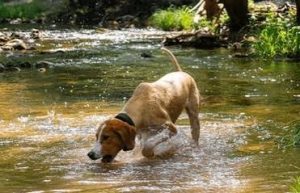
Puppies, senior dogs, and dogs with weaker immune systems are the ones most at risk of a serious outcome — very young, very old, or already-sick animals are the most likely to become seriously ill from an E. coli infection, similar to the pattern in humans.
It’s also worth knowing that E. coli isn’t the only hazard in a stream like Sligo or Long Branch. The same conditions that breed E. coli often come with other risks, including Leptospira bacteria (which dogs can pick up from lakes, rivers, and streams), the water mold that causes pythiosis, and blue-green algae blooms, which can be toxic in just a few gulps when present. So “creek water” as a category deserves some general caution beyond just E. coli specifically.
And there’s a two-way street here: it’s not just about protecting your dog. Dogs with E. coli infections can pass it on to the humans who handle them, so keeping an infected dog’s waste and living areas away from food prep spaces matters too. Which loops back to one of the biggest, most fixable contributors to the whole problem — pet waste. Properly bagging and disposing of pet waste when you’re out walking is one of the simplest things owners can do to help reduce the bacteria load these creeks carry in the first place.
What About Spring Park’s Natural Spring?
This is where the contrast gets interesting. Long before Sligo Creek and Long Branch were part of a paved, storm-drained suburb, Takoma Park’s identity was built around clean spring water. Two natural springs — Little Spring and Takoma Spring, sometimes called Big Spring — originally supplied residents with their drinking water, and the developer who founded Takoma Park specifically marketed the area’s springs, at one point even bottling and selling the water as far away as New York. That spring water is the product of rainwater filtered slowly through cracks and rock layers dating back hundreds of millions of years — a completely different process than a creek collecting street runoff.
Today’s Spring Park still carries that name and a small spring runs beside the playground, but it’s important not to over-romanticize it: a spring’s water quality today depends heavily on current-day protection and testing, not just its historic reputation. A spring that isn’t actively monitored the way Sligo Creek is (with regular published E. coli readings) simply doesn’t have the same public data trail. The honest comparison isn’t “spring good, creek bad” — it’s that groundwater-fed springs are generally less exposed to surface stormwater runoff and pet waste than an open urban creek, but that doesn’t automatically make untested spring water safe for drinking either, for you or your dog.
The Practical Takeaway
- Walking and hiking along Sligo Creek or Long Branch: perfectly fine, any day.
- Letting your dog wade or drink directly from the creek: best avoided, especially in summer and especially within 48 hours after rain, when bacterial counts run highest.
- Bring water from home. A collapsible bowl and a bottle of tap water solves this completely — it’s the single easiest way to eliminate the risk.
- Watch for symptoms if your dog does drink from the creek — vomiting, diarrhea, or unusual lethargy in the following day or two is worth a call to your vet.
- Bag the poop. It’s not just a courtesy — pet waste is a real, documented contributor to the bacteria levels in these exact creeks.
- Don’t assume “spring” automatically means “safe.” Historic springs like the one at Spring Park have a genuinely different water source than a stormwater-fed creek, but that’s a reason for cautious optimism, not a green light to skip the water bowl.
None of this means Sligo Creek or Long Branch are unsafe to enjoy — thousands of people and dogs walk, run, and bike alongside them every week without issue. It just means the “let them drink from the creek” instinct is worth resisting, particularly for puppies, senior dogs, or pups with sensitive stomachs. A little preparation goes a long way toward keeping every creek walk a good one. If you live near these water sources, please let us know if you are absolutely opposed to having your dog in them.
Recent Comments